Introduction
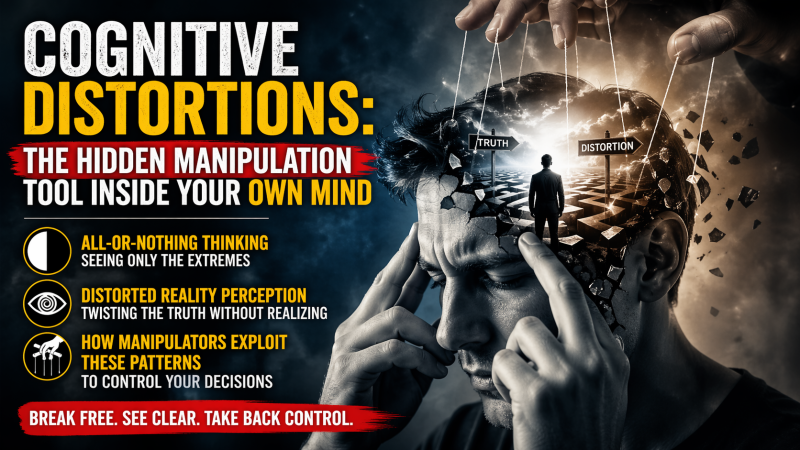
Have you ever felt like your thoughts are working against you? You’re not alone. Cognitive distortions—subtle mental biases—can quietly shape how you see reality. What’s more concerning is that these distorted thinking patterns are often exploited by manipulators to influence your decisions, emotions, and behavior.
Understanding how this works is the first step toward reclaiming control over your mind.
What Are Cognitive Distortions?
Cognitive distortions are irrational or exaggerated thought patterns that distort reality. They often happen automatically, making them difficult to detect.
These mental shortcuts are studied in Cognitive Behavioral Therapy (CBT), where they are recognized as a major cause of anxiety, stress, and poor decision-making.
All-or-Nothing Thinking: Seeing Only Extremes
One of the most common distortions is all-or-nothing thinking (also called black-and-white thinking).
Examples:
- “If I fail once, I’m a complete failure.”
- “If they disagree with me, they must hate me.”
This pattern eliminates nuance, forcing reality into extremes.
Why It’s Dangerous
Manipulators thrive on this mindset because it:
- Simplifies complex situations
- Creates emotional vulnerability
- Pushes people toward impulsive decisions
Distorted Reality Perception: When Truth Gets Twisted
Another powerful distortion is misinterpreting reality. This includes:
- Jumping to conclusions
- Assuming intentions without evidence
- Overgeneralizing from one event
Example:
Someone doesn’t reply to your message → You assume they’re ignoring you → Emotional reaction follows
In reality, there could be countless neutral explanations.
How Manipulators Exploit Cognitive Distortions
Manipulators don’t need to control reality—they just need to control your perception of it.
1. Amplifying Fear and Doubt
They may highlight worst-case scenarios to trigger all-or-nothing thinking.
2. Creating False Narratives
By selectively presenting information, they distort your understanding of events.
3. Gaslighting
A well-known manipulation tactic where someone makes you question your own reality. Over time, this weakens your confidence in your judgment.
4. Emotional Triggering
They push emotional buttons so your distorted thinking takes over, reducing rational analysis.
Signs You’re Being Mentally Manipulated
Watch for these warning signs:
- You constantly doubt your own judgment
- You feel confused after conversations
- You’re pushed to make quick, emotional decisions
- You see situations in extremes (all good or all bad)
How to Break Free From Cognitive Distortions
1. Question Your Thoughts
Ask yourself: Is this fact or assumption?
2. Look for Evidence
Challenge your thinking with real data, not emotions.
3. Embrace Gray Areas
Most situations are not black and white—train your mind to see nuance.
4. Pause Before Reacting
Slowing down reduces the power of emotional manipulation.
5. Learn Psychological Awareness
Studying concepts like Cognitive Bias helps you recognize patterns early.
Why Awareness Is Your Strongest Defense
Once you understand how cognitive distortions work, manipulation becomes easier to detect. Awareness creates a mental “filter” that protects your decisions and emotional well-being.
Conclusion
Cognitive distortions are not just harmless thinking errors—they can become powerful tools for manipulation if left unchecked. Patterns like all-or-nothing thinking and distorted perception make it easier for others to influence your reality.
The good news? You can take control. By recognizing these mental traps and challenging your thoughts, you build resilience against manipulation and start seeing the world more clearly.