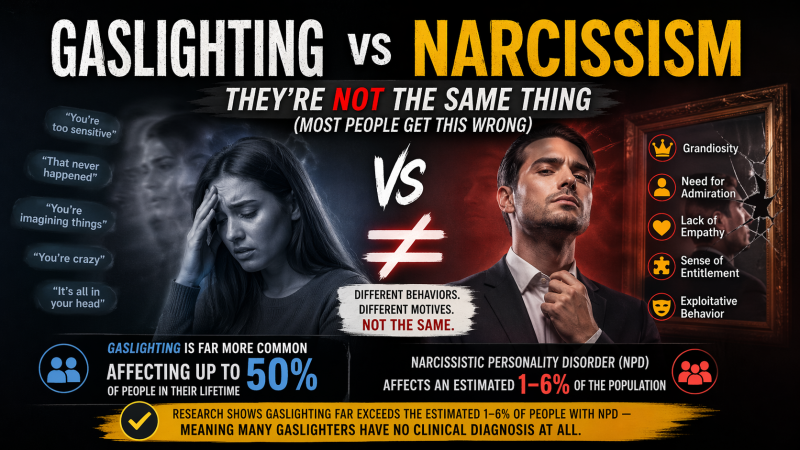
Gaslighting is a behavioural tactic of manipulative abuse, not a medical diagnosis. It involves repeated tactics – lying, denying, shaming – that cause the victim to doubt their own reality. Narcissistic Personality Disorder (NPD), by contrast, is a clinically-defined mental health condition (DSM-5/ICD-11) characterized by pervasive grandiosity, need for admiration, and lack of empathy. Although narcissists may use gaslighting, most gaslighting perpetrators are not diagnosed with NPD. Research shows gaslighting occurs in a variety of contexts (intimate relationships, workplaces, healthcare, online) and can be perpetrated by people with many personality traits (e.g. insecure, antisocial, Machiavellian), not only narcissists.
Recent studies (mostly small-scale and DV-focused) indicate gaslighting is common in abusive relationships: e.g. ~74% of female intimate-partner violence survivors report being gaslit. By contrast, NPD affects only about 1–2% of the U.S. population. This gap means most gaslighters do not have NPD. Antisocial traits – not just narcissism – strongly correlate with gaslighting.
This report provides (1) a clear distinction between gaslighting and narcissism, (2) diagnostic criteria and traits of NPD versus common gaslighting tactics, (3) evidence that gaslighting extends beyond narcissistic abusers, (4) signs and red flags of gaslighting, and (5) practical safety and recovery guidance for victims. SEO elements (target keywords, tags, structured data) and AdSense compliance considerations are integrated, with tables and Mermaid charts to enhance clarity. Citations draw on APA, mental-health authorities, and peer-reviewed reviews to ensure accuracy.
Gaslighting vs Narcissism: Key Distinctions
Gaslighting is not a clinical disorder but a pattern of manipulative behaviour. It involves repeated tactics – lying, deflection, blame-shifting – aimed at making someone doubt their perceptions or sanity. By contrast, narcissism (in popular use) is a personality trait/behaviour; Narcissistic Personality Disorder (NPD) is the clinical diagnosis defined in DSM-5/ICD-11. NPD is characterized by a pervasive pattern of grandiosity, constant need for admiration, and lack of empathy, starting by early adulthood.
People often use “narcissist” and “gaslighter” interchangeably, but they differ fundamentally: Narcissism is an enduring personality pattern (often hidden behind a false self-image of superiority), whereas gaslighting is a specific abusive tactic. Importantly, not all narcissists gaslight, and many gaslighters are not narcissists. A therapist explains: “gaslighting… causes the victim to doubt… their perception, identity, and self-worth”. In essence, narcissists want others to worship them, while gaslighters want others to submit to them. Table 1 below contrasts their core attributes:
| Attribute | Narcissistic Personality Disorder (NPD) | Gaslighting (Manipulation) |
|---|---|---|
| Nature | A diagnosable mental disorder (DSM-5/ICD-11) | A set of abusive behaviours/tactics (no DSM category) |
| Key Features | Grandiosity, need for admiration, entitlement, lack of empathy | Persistent lying/denial, blame-shifting, trivialising victim’s feelings |
| Motivation | Ego protection; sustaining a false grandiose self-image | Power/control over victim; satisfying personal agenda (often antisocial traits) |
| Self-View | Sees self as “special” or superior; sensitive to criticism | May portray self as dominant, infallible; often lacks empathy |
| Behavioural Focus | Generally seeks admiration, praise, and avoids threats to self-image | Seeks to destabilise victim’s confidence and reality; enjoys victim’s confusion |
| Overlap | Some narcissists employ gaslighting as a tactic, but it is not required for the diagnosis | Gaslighting can be done by people without NPD (e.g. antisocial or insecure personalities) |
Prevalence & Scope
Narcissistic Personality Disorder is relatively rare. Studies estimate NPD affects only about 1–2% of the U.S. population. (Earlier reports varied; one 2011 study found ~6%, but APA’s 2024 summary cites 1–2%.) Even including subclinical narcissistic traits, clinical NPD remains uncommon.
By contrast, gaslighting is widespread as a form of emotional abuse. Reliable large-scale prevalence data are sparse, but domestic abuse surveys indicate it is common among abuse victims. For example, about 74% of female intimate-partner violence (IPV) survivors reported experiencing gaslighting in their relationship. (Other reports of domestic violence echo similar figures.) Gaslighting also occurs in non-domestic settings: in workplaces, among friends/family, even in healthcare (“medical gaslighting” occurs when doctors dismiss patients’ concerns). Figure 1 (below) shows a timeline of gaslighting research and awareness highlights.
| Measure | Estimate | Source |
|---|---|---|
| NPD (general population) | ~1–2% (US adults) | DSM-5 text, APA (2024) |
| Gaslighting (IPV survivors) | ~74% of female IPV survivors | National DV Hotline report |
| Domestic violence (general) | >30% women, 25% men (any IPV) | WHO/IPV studies (see [20†L198-L206]) |
| Medical gaslighting (patients) | 70–90% of patients (some groups) | 2023 patient surveys |
Note: Gaslighting statistics are hard to generalize; the above reflects studies of abuse contexts. What matters is that gaslighting is far more prevalent than NPD. Since NPD is rare, most gaslighters are not clinically narcissistic. Instead, research finds gaslighters often share antisocial or Machiavellian traits.
Narcissistic Personality Disorder (NPD): Diagnostic Criteria
The DSM-5-TR criteria for NPD (Box below) require a pervasive pattern of grandiosity, need for admiration, and lack of empathy, beginning by early adulthood. NPD individuals must meet at least 5 of these 9 criteria (similar in ICD-11’s trait model):
- Grandiose self-importance: Exaggerates achievements/talents; expects to be seen as superior.
- Fantasies: Preoccupation with unlimited success, power, brilliance, beauty, or ideal love.
- Special status belief: Believes they are unique and only understood by other “special” high-status people.
- Excessive admiration: Requires constant praise and attention.
- Sense of entitlement: Unreasonable expectations of favourable treatment or compliance.
- Exploitativeness: Takes advantage of others to achieve ends.
- Lack of empathy: Unwilling or unable to recognize others’ feelings/needs.
- Envy/Belief in others’ envy: Often envious of others, or believes others envy them.
- Arrogance: Exhibits haughty, patronizing behaviours or attitudes.
DSM source: APA DSM-5-TR (2022). Note these traits are inflexible and maladaptive, impairing the person’s functioning or causing distress. Simply having some narcissistic qualities (grandiose moments, sensitivity to criticism, etc.) does not mean one has NPD.
Common Narcissistic Traits (not exclusive to NPD): The APA notes even people without the disorder can show narcissistic behaviors (grandiosity, self-absorption), especially under stress. But only pathological levels of these traits that pervade all aspects of life (and harm relationships) warrant a diagnosis.
Narcissistic Traits vs Gaslighting Tactics (H2)
Table 3 contrasts typical narcissistic traits (or NPD symptoms) with gaslighting behaviours. This highlights overlaps (e.g. lack of empathy) and key distinctions (motivation and focus):
| Aspect | Narcissistic Traits/NPD | Gaslighting Tactics |
|---|---|---|
| Empathy | Lack empathy or dismisses others’ feelings | Similarly invalidates/vilifies victim’s feelings (e.g. “you’re too sensitive”) |
| Self-Image | Inflated self-importance; grandiose self-image | Maintains a façade of infallibility; gaslighter’s self-image often dominant and controlling |
| Attention Seeking | Craves admiration and validation | May not overtly seek praise, but seeks power/control; may alternate with praise to confuse (love-bombing) |
| Blame and Defense | Shames/blames others to protect ego; reacts badly to criticism | Accuses victim of causing problems; doubles down on lies when challenged |
| Reality Distortion | May lie or exaggerate to seem superior | Systematically denies or distorts facts to confuse victim |
| Control Tactics | May exploit others for gain; can be manipulative (via charm/guilt) | Explicitly manipulates to make victim doubt reality; isolates victim to increase dependency |
| View of Relationships | Often competitive; expects deference or envy from others | Regards relationships as adversarial; “offense is the best defense” (gaslighters fight by confusing) |
| Typical Behaviours | Showing off, interrupting, belittling; arrogant comments | Denying events happened, trivializing feelings, switching blame, lying repeatedly |
Insight: Both narcissists and gaslighters share arrogance, boundary violations, and emotional manipulation, but narcissists principally inflate themselves, whereas gaslighters primarily seek to invalidate others. As one expert puts it, “Narcissists want others to worship them, while gaslighters want others to submit to them.”
Non-Clinical Profiles of Gaslighters
Gaslighting is a tactic, not a diagnosis. People who gaslight come from varied psychological profiles, often outside a formal disorder. Key profiles include:
-
Insecure individuals: Those with deep fear of accountability may gaslight to deflect blame. For example, an insecure partner might distort facts (“I never said that”) to avoid responsibility. Such gaslighters often have low self-esteem and use gaslighting to manage shame.
-
Antisocial/Machiavellian personalities: People high in antisocial traits (including Machiavellianism, psychopathy, sadism) lack empathy and see others as tools. Research reviews find antisocial traits are common among gaslighters, sometimes more so than pure narcissism. A person with these traits may gaslight easily as part of a broader pattern of manipulation or exploitation.
-
Narcissistic individuals: Narcissists (including subclinical narcissism) can be gaslighters, but they are a subset. A narcissist may gaslight to regain control when their ego is threatened. However, the defining factor in such cases is the overlapping antisocial dimension – lying and coercing – rather than narcissism alone.
-
Situational/manipulative types: Some people without personality disorders use gaslighting situationally (e.g. to succeed at work, keep family secrets, or manipulate group opinions online). They may have learned it from environments (family, culture) or adapted it as a “defence mechanism”. For example, workplace gaslighters (like bullying managers) often use similar tactics (isolation, misinformation) without having NPD.
In summary, gaslighters tend to share a lack of empathy and guilt and a drive for control. They may derive perverse pleasure from dominating others or simply habitually use deceit as a coping strategy. As a Cleveland Clinic psychologist notes, people who gaslight “may or may not realise they’re doing it, but either way… it can feel confusing and be very damaging”.
Signs, Examples & Red Flags
Recognising gaslighting requires noticing repeated patterns. Key signs a person is gaslighting you include:
- Denial of reality: They flatly deny or question things you know happened: e.g. “That never happened, you’re imagining it,” or “I told you this, why are you forgetting?”.
- Blame-shifting: They blame you for their mistakes or even your own feelings: “You made me do this” or “You’re overreacting as usual”.
- Questioning your memory or sanity: Phrases like “You’re crazy, you must have misremembered,” “You’re too sensitive,” or “You’re making this up” are classic gaslighter phrases.
- Isolating you: Subtly cutting you off from friends/family or making you doubt others’ support, so you rely on them for “the truth”.
- Dismissal and trivialisation: They belittle your feelings (“Stop being dramatic”) or say your concerns are invalid or unimportant.
- Inconsistency/Lies: They frequently lie or change stories. For example, they might promise to do something and later claim they never agreed, leaving you confused.
- No accountability: They rarely apologize, and when confronted they escalate with anger or further denial.
Example dialogue: “You lost my keys, but you’re blaming me? I never said that. You’re always overreacting.” Over time, such exchanges make victims doubt themselves. Gaslighting is often gradual and insidious, not a one-off argument.
Red Flags in Relationships: Signs your partner/friend/colleague may be gaslighting you include constantly second-guessing yourself, feeling confused after discussions, apologising often for things you didn’t do, or noticing you withdraw from social activities because your confidence eroded. Friends or counsellors might observe that you seem anxious or uncertain around this person. If others express concern that you’re being treated unfairly, take note – by design gaslighters make friends and family doubt you.
Guidance for Victims
Gaslighting can deeply damage self-esteem and mental health. Evidence-based advice for victims includes:
-
Trust your perceptions: Remind yourself that gaslighters aim to confuse you. Keep a journal or “reality log” (private diary, voice notes, photos) to document events as they happen. Written or recorded evidence (texts, emails, pictures) can validate your experience later. This habit is crucial: it anchors you in facts when memories are gaslit.
-
Talk to others: Share your experiences with trusted friends, family or a counsellor. External perspectives can confirm reality. As one DV advocate advises, explain to someone: “I think I’m being gaslit and I want to talk about what’s happening”. An outside ear can reaffirm what you said or noticed, countering isolation.
-
Set boundaries: Minimise contact with the gaslighter when possible. If you must interact (e.g. co-parenting), try to stay calm and stick to facts. Do not engage in arguing about what “really happened”; the gaslighter wants an argument and to undermine your confidence. Instead, calmly say “Let me think about this,” or walk away.
-
Safety plan: If gaslighting is part of intimate-partner or family abuse, it often occurs with other forms of abuse. Develop a safety plan: identify escape routes, keep important documents/money accessible, and inform a friend or hotline of the situation. The National Domestic Violence Hotline (UK Samaritans, Refuge) can offer resources. Remember, you deserve to be safe.
-
Therapy and support groups: Seek professional help from therapists who understand psychological abuse. Research suggests trauma-informed therapy (CBT, counseling) helps victims recover trust in themselves. The Hotline emphasizes therapy (with a DV-experienced clinician) to address the confusion and paranoia gaslighting causes. Support groups (online or local) for abuse survivors can also help you feel understood.
-
Legal and online safety: Gaslighting alone is hard to prosecute, but if it coincides with physical threat or stalking, contact authorities. Keep evidence (messages, emails) in case you need legal protection. Online, use privacy tools: block the person on social media, adjust privacy settings, and avoid engaging in public arguments (which gaslighters may record or manipulate).
-
Self-care and self-trust: Rebuild confidence by trusting yourself. Remind yourself “my feelings and memories are valid”. Engage in activities that boost self-worth (hobbies, exercise, meditation). Mental health charities recommend self-care routines and possibly antidepressant or anxiety treatments if needed – but always in consultation with a professional.
“No matter the form of documentation, always keep your proof safe… Recovering from gaslighting… can be difficult; seeing proof validates your experience and helps challenge the abuser’s narrative.”
In sum: protecting yourself from gaslighting involves gathering objective “proof,” leaning on supportive relationships, and setting firm personal boundaries. As one DV resource notes, don’t waste energy trying to “convince” the gaslighter; instead, focus on knowing your truth and seeking external validation.
Q: What is gaslighting?
A: Gaslighting is a form of psychological manipulation/abuse where the abuser repeatedly lies, denies or distorts reality to make the victim doubt their own perceptions and memory. It often leaves the victim feeling confused, anxious, and questioning what is real.
Q: How is narcissism different from gaslighting?
A: Narcissism (specifically Narcissistic Personality Disorder) is a clinical condition marked by grandiosity, need for admiration, and lack of empathy. Gaslighting is just one possible tactic an abuser (sometimes a narcissist) might use. One can be gaslit by someone who is not narcissistic. In short, narcissism is a personality disorder, while gaslighting is an abusive behaviour.
Q: What are common signs that someone is gaslighting you?
A: Look for patterns of denial, blaming, and minimizing your feelings. For example, they may frequently say you’re “too sensitive” or that you “remember wrong,” shift blame onto you, or contradict past events. If you constantly second-guess yourself around them and feel confused after conversations, those are red flags.
Q: Can a person without a personality disorder gaslight?
A: Yes. Research shows that gaslighting perpetrators often have antisocial or controlling traits, not necessarily full-blown NPD. Insecure or scheming people (even with otherwise normal personalities) can use gaslighting tactics. The key factor is a willingness to manipulate and a lack of empathy, which can occur in many personality types.
Q: How can I protect myself or get help?
A: Keep records of incidents (e.g. journal, messages) to validate your experience. Talk to trusted friends or a therapist (preferably with domestic-abuse experience). Set clear boundaries with the gaslighter. If it’s an abusive relationship, create a safety plan and consider legal protection. Remember: gaslighting is abuse, and you deserve support and safety. Organizations like the National DV Hotline offer confidential advice 24/7.
Q: Is therapy effective for gaslighting victims?
A: Yes. Therapy (especially trauma-informed or abuse-specialist therapy) can help you rebuild trust in yourself and recover from the trauma of gaslighting. It provides tools to set boundaries, improve self-esteem, and heal the confusion gaslighting causes. Always seek qualified mental health professionals; mental health charities can help find one.